
Delhi Township Neighbor Block Records
A block search starts with one verified Delhi Township address and moves outward only as each public record supports it. The local GIS is useful for nearby parcel shapes and planning layers. BS&A holds the current property and tax context for a parcel. Recorded deeds connect transfers across nearby lots. Voter records have redactions and do not supply a free household map. Historical directories and community organizations add context, not a definitive list of Delhi Township neighbors.
| Block source | What it can show nearby | Access and caution |
|---|---|---|
| Delhi GIS parcel layer | Adjacent polygons, approximate lines, zoning, flood, wetland, and park context | Public planning viewer, not a legal survey |
| Delhi BS&A parcel cards | Owner or taxpayer, situs and mailing addresses, assessment, and building context | Free one-parcel or range search; owner is not automatically an occupant |
| Ingham deed index | Recorded transfer parties, document details, and legal descriptions | Older documents may require a vault appointment |
| Permits and agenda packets | Public work or hearing events linked to an address | Office, agenda, or records-request route where no public result search exists |
| Michigan voter records | Individual status and jurisdiction fields subject to redaction | Individual tool or FOIA route, not a block roster |
| Directories and civic groups | Historical street clues or public community-contact paths | Collection coverage varies; no member list is implied |
The key distinction for Delhi Township neighbors is owner versus occupant. A recorded owner, taxpayer, trustee, estate, or mailing contact may appear on a property card. That does not establish who currently lives at the parcel. Preserve the label on the record and avoid filling gaps with an assumption.
GIS Context for a Delhi Township Neighbor
The Delhi Township Interactive Map describes parcels, approximate boundaries and dimensions, parks, zoning, wetlands, and flood information. It also says the map is generalized for planning and reference, accuracy is not guaranteed, and cadastral maps are not legal descriptions. A boundary question belongs with the assessor or a surveyor, not with a screen image or a neighboring parcel outline.
The live viewer directs through a replacement system, and the research could not verify its exact identify, buffer, measuring, printing, or link-to-record controls. Treat the map as a visual starting point. Confirm a parcel identifier on the assessment record before making a note about Delhi Township neighbors, and carry the legal description forward when a deed or boundary is important.
Note: The county replaced an older GIS platform under a 2025 contract, so controls and layers should be checked in the live viewer before relying on them.
Map a Delhi Township Neighbor Block
The adjacent-parcel process keeps the inquiry tied to a small, visible block. Delhi Township's GIS description supports looking at parcels and approximate boundaries, but the research did not capture a live adjacent-parcel control. Use the viewer's available address or parcel path, then confirm each parcel through BS&A rather than treating the map label alone as final.
- Start with the exact street address or parcel in the Delhi Township GIS and note the surrounding parcel shapes without treating the lines as a survey.
- Write down the nearby parcel identifier or legal-description clue available for each parcel, then open that parcel's BS&A record.
- Label the BS&A owner or taxpayer, situs address, and mailing address separately. A mailing address can belong to an estate, lender, agent, or other non-occupant.
- For a transfer question, use the current owner or legal description in the Register of Deeds index and keep the recorded instrument with its date and parties.
When the question grows from one block to a whole road, the Delhi Township street directory provides the fuller address-by-address trail without turning a parcel map into a household list.
Parcel Cards for a Delhi Township Neighbor
Delhi's free BS&A route offers record areas for Assessing, Building Department, Tax, Utility Billing, Special Assessment, and other municipal records. The search modes include address, name, parcel number, and an address-number range. Search a nearby address one at a time or use the range control where it helps orient the block. The research did not confirm a street-wide export, result cap, or live sorting behavior, so an orderly parcel-by-parcel note is more reliable than a claimed complete list.
A vendor sample card can include parcel or account identifiers, GIS links, year built, sale history, owner or taxpayer, land/legal description, and property, tax, building, or utility tabs. Delhi Township may expose fewer fields. Sale history should be cross-checked with the Register of Deeds, and a homestead or exemption flag can support an inference only. It cannot prove every resident at the location.
Deeds Across a Delhi Township Neighbor Block
Recorded deeds show the transaction trail across a block, not a current household roster. From a BS&A record, retain the owner, parcel number, legal description, and any sale-history clue. In the deed index, search the current owner as grantee for the acquisition, then read the instrument for the prior seller, date, document or book reference, and legal description. Search that seller as grantee to move backward only when the document supports the link.
The Ingham County Register of Deeds says pre-1960 documents require a vault appointment, while an exact online-index start year was not located. Plats and subdivision names can be steadier than street numbers when neighboring Delhi Township parcels were renumbered or their postal label changed. A deed proves a recorded party and legal description, not a present occupant or every family member.
Voter Privacy Around Delhi Township Blocks
The Michigan Voter Information Center is a personal status, clerk, polling-place, sample-ballot, and absentee-tracking tool. It is not a public address browser for Delhi Township neighbors. Michigan voter registration records are public under FOIA, but driver-license or state-ID numbers, month and day of birth, phone, email, QVF receiving-office information, digitized signatures, and the last four digits of Social Security numbers are withheld or redacted.
A statewide QVF summary can be requested through the SOS FOIA channel with a defined county, township or precinct, field, and date or version. The record rules still control release. Michigan does not register voters by party, ballot choices are secret, and a person at a parcel may be unregistered, protected, or simply absent from a particular record. Do not infer a block's people from precinct geography.
Community Paths Near Delhi Township
Delhi Township's community layer can help someone find a public event, archive, or contact path. It cannot supply a private member directory. The township recreation plan identifies the groups below, and the township's public resources point to service clubs, community resources, and the Holt-Delhi Historical Society. No public resident or association-member roster was located for these groups, so requests should stay with public activities or historical collections.
| Community organization | Documented public role | Directory status |
|---|---|---|
| Holt Lions and Kiwanis | Named in the Delhi recreation plan | Organization listing only; no public member list located |
| Sam Corey Senior Center Club and Junior Rams | Community program and activity paths | Public program contact, not a household directory |
| American Legion and VFW | Veterans-community contact route | No public member roster located |
| Holt Hometown Festival Committee and Holt Community Arts Council | Event and arts context | No public member roster located |
| Friends of Delhi Trails and Holt Community Connect | Trail and community-resource routes | No public member list located |
| Holt-Delhi Historical Society | Collections and lookup help by contact | Not a public membership or household roster |
Township neighborhood associations and HOAs were not found in an official public umbrella directory. A public event or archive request is appropriate. Asking a civic group to disclose private members is not.
A Delhi Township Block by the Numbers
Delhi Township's official 2020 profile lists 27,710 residents and 11,214 households, while the township's presented population figures show growth from 13,795 in 1970. Those totals give scale to the records landscape. They do not identify people on a block, and they do not overcome the difference between a parcel owner, a postal label, and a present occupant.
Local place names can also shift a historical block search. Delhi Center became Holt in 1860, and the northern third of the original township was annexed to Lansing in the early 1960s. Grovenburg, Miller Road, North District, Five Corners, West Holt, and Maple Grove may appear in historical material instead of a modern Delhi Township label. A map, parcel history, and legal description help test whether the same place is being discussed.
The Holt-Delhi Historical Society's historic maps collection shows the local map layer that can help date a place name or road. It is useful context for historical Delhi Township neighbors, not proof of a current boundary or current occupant.
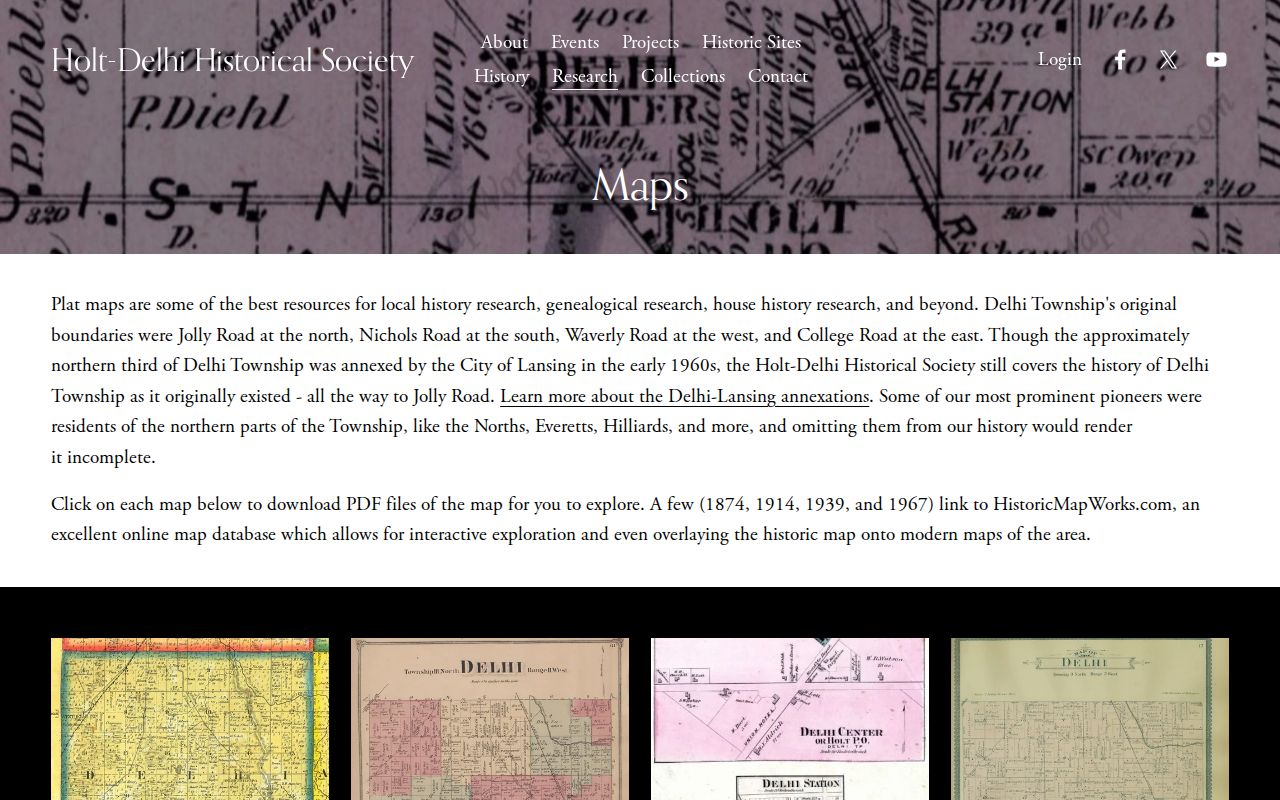
Use the map date, the road name, and an official parcel or deed record together when an old local label conflicts with a current one.
Delhi Township Neighbor Source Comparison
Official custodian records and commercial neighbor tools answer different questions. A commercial result may combine public and licensed material, but it can be stale, incomplete, or joined to the wrong same-name person. It should not replace a Delhi Township parcel, deed, voter, court, or historical record. The comparison below keeps the source type visible before any conclusion is made.
| Source type | Best use | Limit to keep in view |
|---|---|---|
| Official parcel or deed record | Recorded property relationship and legal description | Does not confirm every current occupant |
| Official voter or court route | Defined public status or case information | Redactions, confidentiality, and identity limits apply |
| Library, map, or directory collection | Historical block, address, and community context | Coverage and date limits can leave gaps |
| Commercial neighbor tool | Unverified lead only | May be stale, mismerged, or missing protected information |
Privacy Boundaries for a Delhi Township Neighbor
Some facts about a block remain private or uncertain: renters, other household members, unregistered residents, utility customers, DMV addresses, sealed or juvenile court parties, protected voters, Address Confidentiality Program participants, and nonpublic association members. The Michigan Address Confidentiality Program provides qualifying people with a designated address and mail forwarding. Its protected address does not become public through a parcel or voter search.
Michigan's anti-stalking statute, MCL 750.411h, treats a willful course of conduct that causes terror, fright, intimidation, threat, or harassment as stalking. Public availability does not erase that limit. If a record appears wrong, contact the keeper of that specific parcel, deed, court, or voter record and ask for its correction path.
When a Delhi Township Neighbor Needs an Office
A visual map cannot answer every Delhi Township block question. Ask Delhi Assessing about a property card or parcel issue. Use the Register of Deeds for a recorded instrument and the vault route for older material. Community Development, agenda packets, and a defined records request are the fallback for a permit or planning trail when no public search result exists. CADL, the Historical Society, and the Archives of Michigan are the historical fallback when a directory or map is missing online.
For a Michigan FOIA request, describe the address, parcel, record type, and time range. The request should seek a defined public record, not every detail about nearby people. Courts follow their own clerk access rules, and an official response may confirm that a record is confidential, unavailable, or held only in person.
Note: A clear parcel number and date range help a custodian locate a record without turning a block question into an overbroad request.